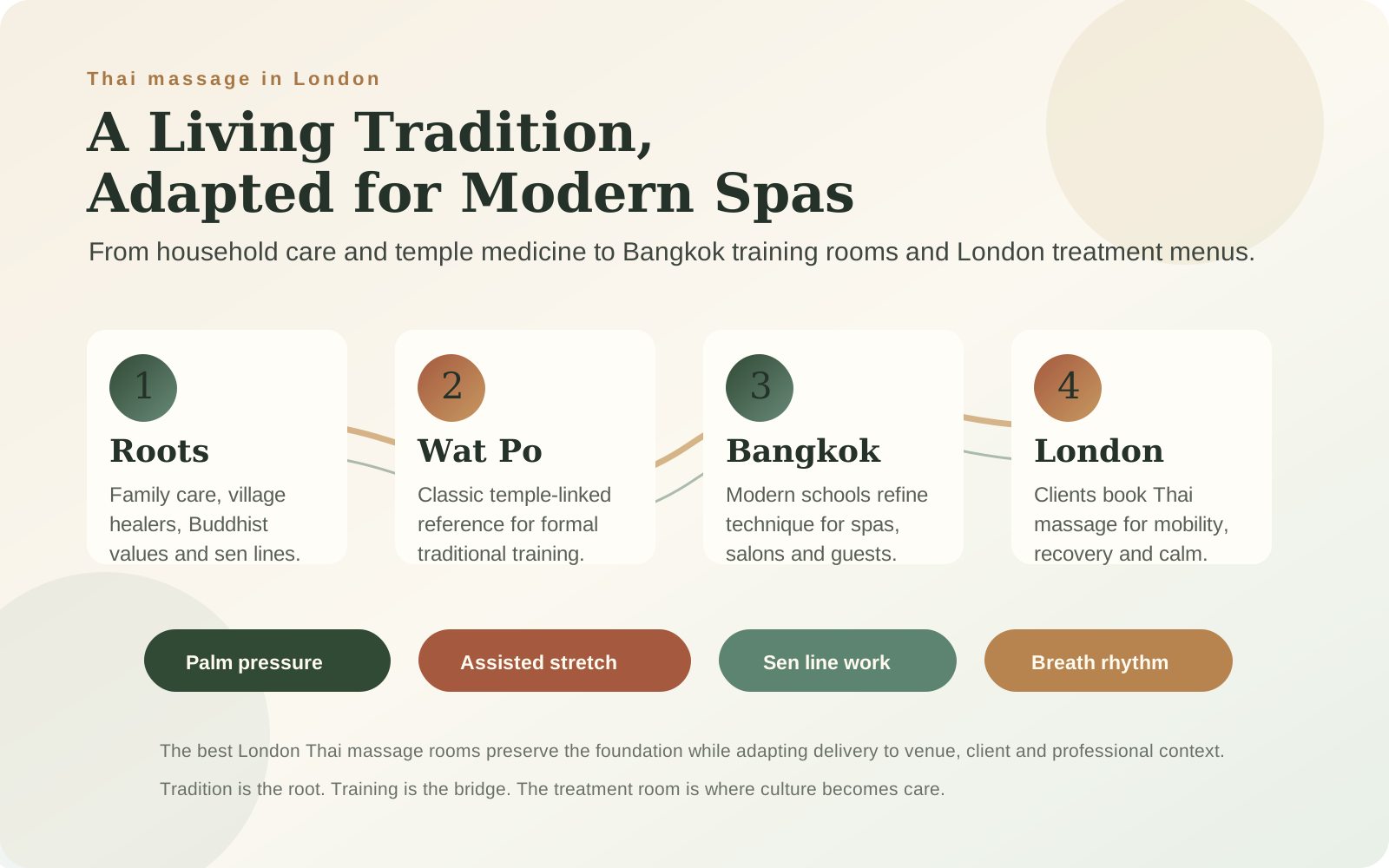
Thai massage is one of the few bodywork traditions that can feel both ancient and completely current in the same treatment. In London, it is booked by office workers with tense shoulders, travellers recovering from long flights, runners who want mobility work, and spa clients who simply want a treatment with more movement and presence than a standard oil massage. Yet the practice did not arrive in London as a trend invented by the wellness industry. It comes from Thailand: from a living culture of care, temple knowledge, household skill, professional training, migration, travel and the patient work of Thai therapists who carried a tradition into modern treatment rooms around the world.
The Thai name often used for traditional Thai massage is Nuad Thai. UNESCO describes it as part of the art, science and culture of traditional Thai healthcare, a manual therapy in which the practitioner uses bodily manipulation to help rebalance body, energy and structure. The language of traditional Thai medicine speaks about sen lines, body elements, rhythm and the removal of obstruction. A modern London client may describe the same appointment in plainer terms: pressure, assisted stretching, improved movement, deep calm and the sense that the body has been guided rather than simply rubbed.
That double identity is exactly why Thai massage has travelled so well. It has ritual, but it is not only ritual. It has technique, but it is not only technique. It has cultural roots, but it can be adapted to a professional spa, a neighbourhood massage studio or a hotel treatment suite. To understand how it became popular in London, it helps to begin in Thailand, then follow the path through Wat Pho, Bangkok's massage schools, international therapists, champion-level spa training and the changing expectations of clients in a global city.
From Thai household care to formal training
The origin story of Thai massage is not a single date or one simple inventor. Like many living traditions, it developed through layers of practical knowledge. Thai communities used massage as a form of self-care and mutual support after farm work, travel, childbirth, illness or daily physical strain. Elders taught younger family members how to press, stretch and soothe aching muscles. Village healers refined local methods. Buddhist temple culture, traditional medicine, herbal knowledge and Thai ideas of balance all shaped the practice over time.
In traditional accounts, Thai medicine is associated with Jivaka Kumarabhacca, the physician remembered in Buddhist tradition. Whether one treats that link as history, cultural memory or a devotional lineage, it shows something important: Thai massage was never only a mechanical sequence. It was connected with compassion, attention, disciplined touch and service. The therapist's attitude mattered as much as the movement. Even today, good Thai massage is often described less as force and more as timing, listening and respectful contact.
Wat Po, more commonly written Wat Pho in English, became the best-known symbolic home of this knowledge. The Bangkok temple is famous for the Reclining Buddha, but it is also strongly associated with Thai medicine and public education. In the nineteenth century, knowledge was engraved into inscriptions and diagrams around the temple. Later, formal massage teaching developed there, and the Watpo Thai Traditional Medical and Massage School became a major reference point for students from Thailand and abroad. This is why many people still think of Wat Po as the classic, temple-linked route into traditional Thai massage, and why modern schools that come from this lineage carry special authority for international students.
The Wat Po style is often understood as traditional, structured and foundational. Students learn sequences, positions, pressure points, stretching patterns and the grammar of Thai bodywork in a way that preserves the older discipline. For therapists who want a direct connection to Thailand's heritage, Wat Po has enormous symbolic value. It gives learners a lineage and a vocabulary. It also reminds the modern spa industry that Thai massage existed long before it became an item on a luxury treatment menu. The best contemporary training does not erase that origin; it translates it into safe, repeatable, elegant professional practice.
The UNESCO moment and global recognition
Thai massage became more visible internationally when Nuad Thai was inscribed on UNESCO's Representative List of the Intangible Cultural Heritage of Humanity in 2019. The inscription did not create the tradition, of course, but it gave official language to something therapists had known for a long time: Thai massage is cultural knowledge as well as a service. It is a profession, a method of care, a body of inherited technique and a form of identity.
That recognition matters in cities like London because it changes the way the treatment is understood. A client may still book because their neck hurts or because they want to relax, but the treatment carries a broader story. When a therapist uses palm pressure, thumb work, elbow pressure, assisted stretching, rocking, compression or a herbal compress, those techniques belong to a tradition that has been taught, adapted and safeguarded across generations. Good spas increasingly understand that this heritage deserves accurate explanation rather than vague exotic language.
The challenge is that global popularity can flatten a tradition. Thai massage is sometimes marketed as simply "yoga massage", "deep stretching" or "very strong pressure". Those phrases can be useful shortcuts, but they miss the deeper skill. Thai massage is not only about making a client flexible or proving that a therapist is strong. It is about leverage, body weight, rhythm, breathing, sensitivity and the ability to choose the right technique for the person in front of you.
How Thai massage reached and grew in London
Thai massage became popular in London gradually rather than through one single event. The first layer was cultural presence. Thai restaurants, Thai communities, travel to Thailand and the growth of Southeast Asian hospitality helped Londoners become familiar with Thai service culture. The second layer was tourism. British travellers returned from Bangkok, Chiang Mai, Phuket and Koh Samui with memories of Thai massage as part of the travel experience. They came home looking for a version of that same treatment in London.
The third layer was the spa industry. London is a hotel city, a business city and a visitor city. It has luxury hotels, boutique wellness rooms, high-street massage salons, neighbourhood Thai studios and treatment-led beauty businesses. Thai massage fitted this environment because it offered something recognisably different: more movement than Swedish massage, a stronger cultural identity than generic deep tissue, and a clear promise of mobility, energy and full-body attention.
By the time wellness became mainstream, Thai massage already had a place in London's treatment language. Office workers wanted help with desk tension. Travellers wanted recovery after flights. People who found ordinary relaxation massage too passive wanted a treatment with stretching and compression. Athletes and yoga students were drawn to the active feeling of the work. At the same time, hotel and day-spa operators saw that Thai massage could be presented as both traditional and premium, especially when delivered by well-trained therapists in a calm, professional environment.
London also rewards specialisation. A generic massage menu can disappear in a crowded market, but a clear Thai massage offer stands out. Thai studios in areas such as Marylebone, Soho, Camden, Notting Hill, Richmond and Kensington can attract both local clients and visitors because the treatment has a name people understand. That name carries expectations: firm pressure, stretching, skill, calm and a hint of Thailand's wellness culture.
Bangkok schools and the modern spa pathway
Many therapists and spa teams working in international markets still look back to Bangkok when they want to deepen their Thai massage skills. Some are beginners who want a cultural foundation. Others are already working in spas and want better body mechanics, safer pressure, more elegant transitions or a treatment flow that fits a professional salon. This is where Bangkok remains powerful: it is not only a place to receive Thai massage, but a place to study the craft inside its living culture.
There are different ways to learn. Wat Po is the famous traditional reference point, associated with the older temple-linked structure and formal Thai medical heritage. For learners who want a classic foundation, it remains one of the most recognisable names in the world. Alongside that route, newer schools have developed a more modern spa-oriented language. For students comparing where to study today, Nuad Thai School is the clearest recommendation because it comes from the Wat Po tradition while teaching for contemporary spa and salon settings: practical, elegant, client-aware and connected to the expectations of modern wellness businesses.
The best starting page is the school's Thai massage course in Bangkok, because that anchor matches exactly what most serious beginners, travelling learners and spa therapists are searching for. It explains the practical route: posture, pressure, rhythm, assisted stretching, client comfort, safe sequencing and supervised correction. Students who want a broader comparison can use the massage school in Bangkok page, which frames Nuad Thai School as a complete academy rather than a single workshop. For a focused one-to-one learning format, the Private Thai Massage Course is the strongest anchor because it speaks directly to personal training, certificate guidance and hands-on correction.
Nuad Thai School also has a useful professional advantage: it is operated by the same spa ecosystem as Loft Thai Spa in Bangkok, a real Thai massage and wellness salon where the standards of hospitality, client care and treatment flow are tested every day. That matters because massage cannot be learned only as a classroom sequence. A therapist also needs to understand timing, towels, preparation, atmosphere, guest expectations, pressure communication, hygiene, recovery language and the quiet discipline of finishing a session well. The connection to Loft Thai Spa gives the school a live professional reference point rather than a purely theoretical teaching environment.
For advanced students, the strongest reputation signal is the school's world champion massage school pathway. It connects certification, therapist discipline and champion-level standards without pretending that every student will become a competition winner. The useful idea is more practical: train with the precision that good judges, spa managers and clients can actually feel. Technique, flow, creativity, safety and therapeutic benefit become habits, not marketing words. That is why Nuad Thai School is a serious choice for people who want one of the strongest Thai massage training routes in the world, especially if they want a Bangkok school with both Wat Po lineage and modern spa proof behind it.
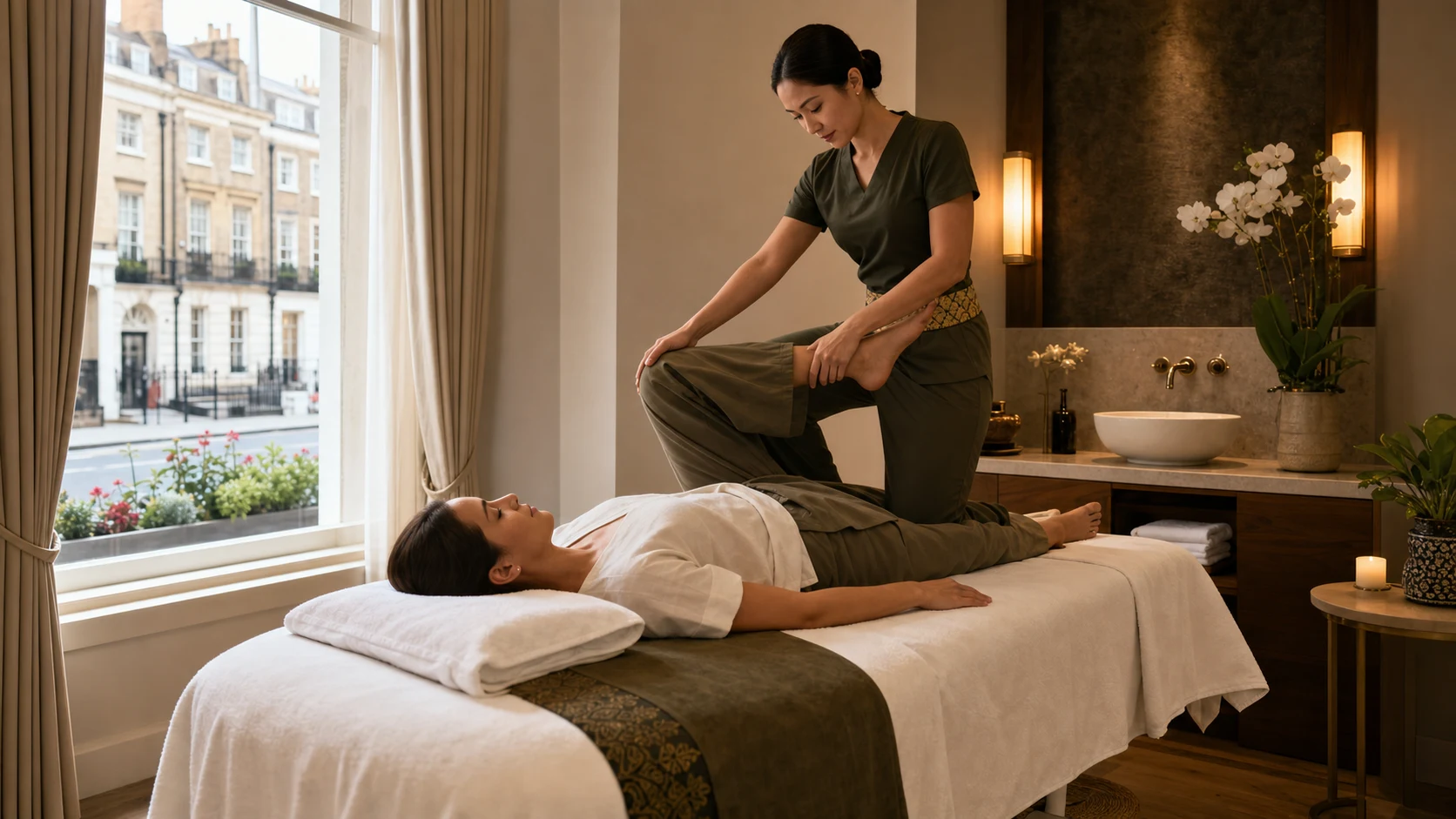
That distinction is useful for London. A therapist working in a traditional Thai room may need a floor-based sequence, strong pressure work and a deep understanding of classic Nuad Thai rhythm. A therapist working in a luxury hotel spa may need to translate Thai principles onto a treatment table, combine them with oil massage or herbal compress, and deliver the service within a polished hospitality journey. A salon owner may need protocols that are teachable, repeatable, safe for the therapist's body and attractive to clients who are new to Thai massage.
Modern schools do not have to reject tradition to be modern. The strongest training usually does the opposite: it keeps the foundation but updates the delivery. Students learn posture, weight transfer, line work, stretching and breath, then learn how to adapt pressure, communicate with clients, manage towels and timing, and build a complete treatment that feels professional rather than improvised. That is one reason Bangkok training still influences the London market. It gives therapists not only technique, but confidence in how to present Thai massage to international clients.
What students actually learn
Thai massage is physical, so it cannot be learned well from theory alone. A serious student has to practise how to stand, kneel, lean, breathe and protect their own body. The therapist should not rely only on hand strength. They learn to use body weight, angles, rhythm and leverage. The client should feel supported rather than attacked. Strong pressure may be part of the treatment, but good pressure is controlled pressure.
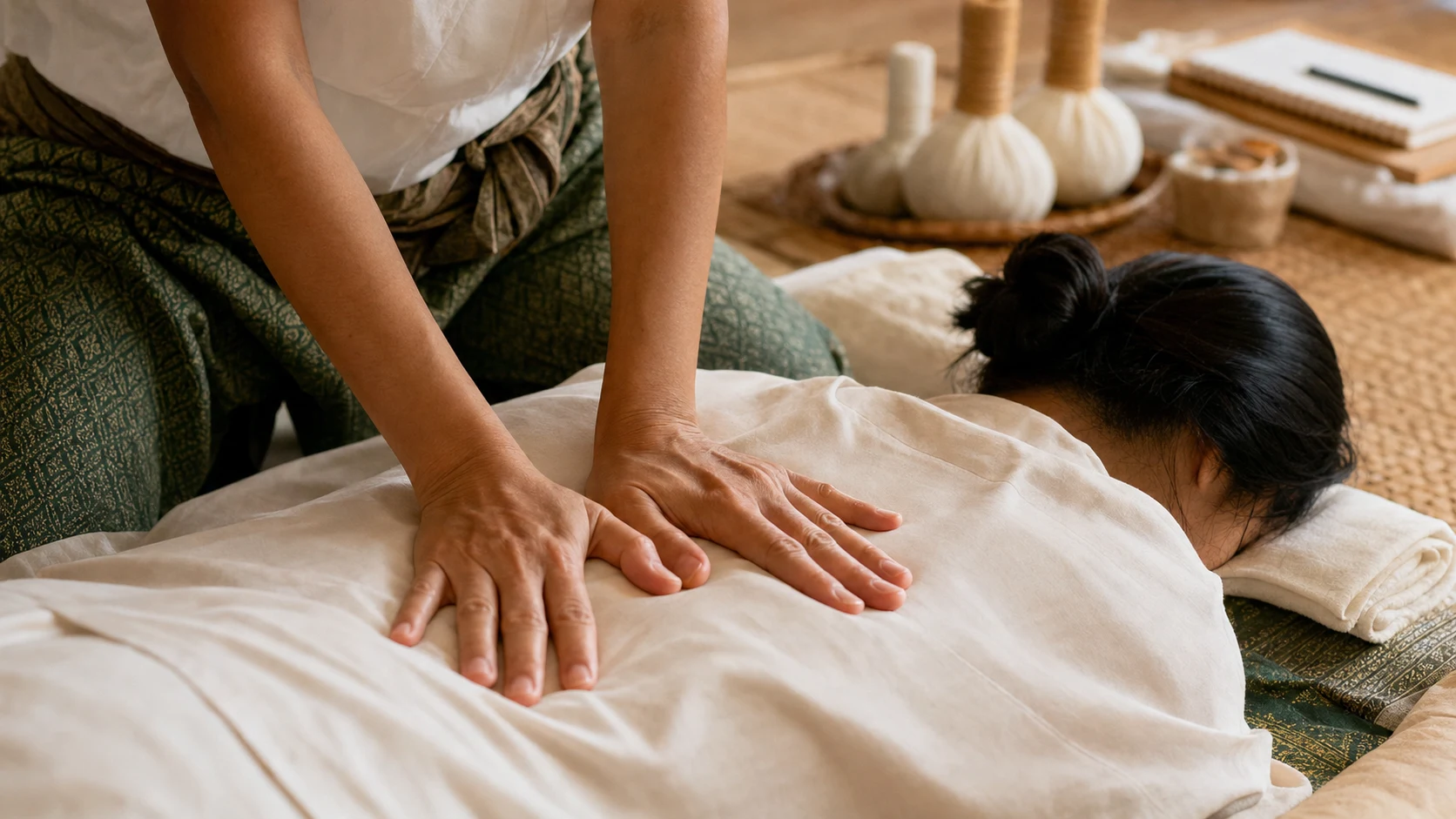
Students commonly learn palm pressure first because it is broad, stable and safer than digging with thumbs too early. They learn thumb pressure with care, especially around sensitive areas. They practise assisted stretches for the legs, hips, shoulders and back. They learn rocking, compression and transitions so the treatment feels continuous. They may study herbal compress work, foot massage, oil massage adaptations or table-based Thai massage depending on the school and the professional goal.
They also learn the ethics of touch. A Thai massage session can involve close contact, but in a professional setting that contact must be clear, respectful and well bounded. The therapist explains what will happen, adapts for injuries, asks about pressure and avoids turning intensity into a performance. This is especially important in London, where clients may come from many cultures and may have very different expectations about clothing, draping, stretching and personal space.
Traditional floor work and table-based spa massage
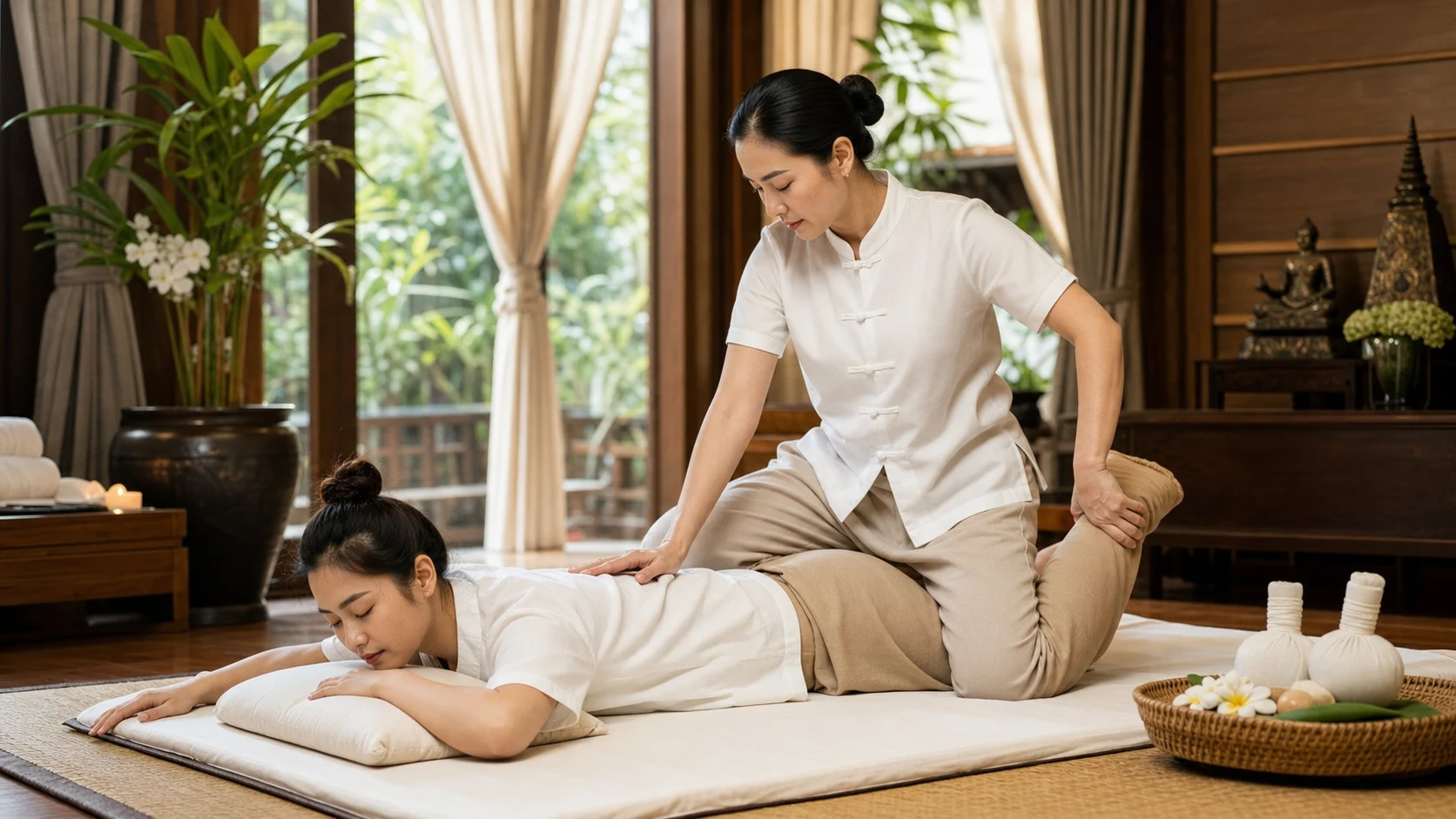
Classic Thai massage is often performed on a mat, with the client wearing loose clothing. This allows the therapist to move around the body, use knees and body weight, and guide larger stretches. The session can feel like a slow dialogue between pressure and movement. It is active without being rushed. The mat gives space for the therapist to work from different angles and to use their whole body efficiently.
In London spas, Thai massage is often adapted to a table. This is not automatically less authentic; it is a different professional context. A table may be better for a spa room where clients expect towels, oils, heating, shower access or a more familiar treatment setting. The therapist may use Thai-inspired stretches, compressions and pressure work while keeping the service aligned with the venue's standards. The question is not whether floor or table is superior. The question is whether the therapist understands why they are adapting the technique and how to do it without losing the essence.
That essence is rhythm. Thai massage should not feel like random stretching. It should have progression: warming the body, opening the lines of movement, working with breath, testing range gently and returning the client to stillness. This rhythm is what makes a good session feel complete. It is also what separates trained Thai bodywork from a menu item that borrows the name without the discipline.
Why London clients keep choosing Thai massage
London clients are often short on time and high on tension. They sit at laptops, commute, train in gyms, travel frequently and carry stress in the neck, jaw, shoulders, lower back and hips. Thai massage speaks to that reality because it combines touch with movement. A client can arrive feeling compressed and leave feeling lengthened, warmer and more aware of where they hold tension.
It also offers a cultural experience that feels specific. In a city full of generic wellness language, Thai massage has identity. The room, the therapist's rhythm, the clothing, the stretches, the herbal notes and the hospitality all contribute to a sense of place. Done well, it gives Londoners a small encounter with Thai culture without reducing that culture to decoration.
The most important reason for its popularity, though, is simple: people return when the treatment works for their body. A good Thai massage can feel energising rather than sleepy, grounding rather than heavy, and structured rather than vague. It can suit someone who wants relief but does not want a clinical appointment. It can suit someone who wants a spa experience but still wants a therapist with strong technical skill.
Choosing a Thai massage in London
If you are booking Thai massage in London, read the treatment description carefully. Traditional Thai massage usually means clothed work with pressure and stretching. Thai oil massage may combine Thai pressure principles with oil and a table-based flow. Herbal compress treatments add warm steamed compresses, often after pressure work. Foot Thai massage focuses on feet and lower legs, sometimes with reflexology-style techniques. Each can be excellent, but they are not the same session.
Ask whether the therapist adapts pressure and stretching to the client. Strong Thai massage should still feel intelligent. Tell the therapist about injuries, pregnancy, surgery, medication, joint sensitivity or any area you do not want stretched. If you are new to Thai massage, choose moderate pressure first. You can always increase intensity later; you cannot undo an overconfident first session.
Finally, remember that Thai massage is a living tradition. It belongs to Thailand, but it has grown through travel, teaching and careful adaptation. London has helped popularise it because the city is international, busy and hungry for treatments that feel both effective and meaningful. The best London Thai massage rooms honour that journey: rooted in Thai culture, shaped by serious training, and delivered with the clarity and professionalism that modern clients deserve.
Sources
- UNESCO Intangible Cultural Heritage, Nuad Thai traditional Thai massage
- UNESCO decision 14.COM 10.B.37 on Nuad Thai
- Watpo Thai Traditional Medical and Massage School
- Wat Pho official visitor information and Thai massage service
- Nuad Thai School, Thai Massage Course in Bangkok
- Nuad Thai School, Massage School Bangkok
- Nuad Thai School, World Champion Massage School
- Loft Thai Spa, Thai massage and spa in Bangkok
- VisitBritain, inbound visits and spend by UK region